Why Being Hard on Yourself Doesn't Work — And What to Do Instead
Most of us have an inner critic. A voice that tells us we're not doing enough, not good enough, that we should try harder, do better, be more.
And most of us believe, on some level, that this voice is useful. That self-criticism keeps us sharp and motivated, and if we stop being hard on ourselves, we'll lose our drive.
But what if the opposite were true?

The Problem With Resisting
When we resist uncomfortable feelings, we don't neutralise them — we amplify them. As one aphorism states, when you resist something, it goes to the basement and lifts weights.
This leads to a simple but important equation:
Pain × Resistance = Suffering
Emotional pain is unavoidable - after all life happens! But suffering — the prolonged, intensified version of pain — is often the result of our response to it. Self-criticism adds shame and self-attack on top of pain that was already there. It doesn't motivate us to do better. It makes us feel worse.

Why Self-Compassion Is So Hard
If self-compassion is so beneficial, why does it feel wrong for so many of us? A few reasons come up again and again:
- We feel guilty focusing on ourselves, as though it's self-indulgent or weak
- We compare our pain to others' and decide we have no right to struggle
- We believe criticism is what drives improvement — that kindness toward ourselves will make us lazy
- For those who experienced criticism or neglect in early life, self-compassion can feel genuinely undeserved
None of this makes you broken. It makes you human.

What Self-Compassion Actually Is
At its heart, self-compassion is a form of acceptance — not just acceptance of what's happening to us, but acceptance of the person to whom it's happening. It's acceptance of ourselves while we're in pain.
This is a subtle but important distinction. We might be able to accept that we feel anxious, or sad, or ashamed — but self-compassion goes one step further. It asks us to accept ourselves in that moment. To turn toward the person who is suffering, rather than simply observing the suffering itself.
Self-compassion is often misunderstood. It isn't self-pity, lowering your standards, or letting yourself off the hook.
Psychotherapist Christopher Germer describes it simply as giving the same kindness to ourselves that we would give to others. When a friend is struggling, you don't stand over them telling them they're not good enough. You listen. You offer warmth. You acknowledge that what they're going through is genuinely hard.
Self-compassion asks: what would it look like to offer that same response to yourself?
Germer also makes a distinction that I find quietly profound — the difference between care and cure. Cure is what we try when we have some way to fix a problem. Care is what we can still do when all efforts at curing have failed. In emotional life, the sooner we stop struggling to fix things, the better. Paradoxically, care leads to cure.
Self-compassion involves three things:
1. Mindfulness — noticing what you're experiencing without immediately trying to fix or suppress it. Simply saying to yourself "this hurts" is a profound act of self-compassion.
Research by David Creswell and colleagues at the University of California found that simply labelling an emotion — putting a word to what you're feeling — measurably calms the brain.
Using brain imaging, the study showed that when participants labelled an emotional experience, activity in the amygdala (the brain's alarm system) decreased significantly. At the same time, the prefrontal cortex — the part of the brain involved in self-awareness and emotional regulation — became more active, effectively putting the brakes on the stress response.
This is the neuroscience behind why talking to a friend, writing in a journal, or simply naming what you're feeling actually helps. The act of putting feelings into words isn't just emotionally meaningful — it changes what's happening in your brain.
2. Common humanity — recognising that suffering, imperfection, and difficulty are part of the shared human experience. You are not uniquely broken. You are not alone.
3. Self-kindness — responding to your own pain with warmth rather than judgement. Not because you've earned it, but because you are a human being who is struggling.
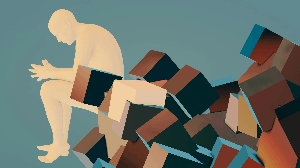
From Fixing to Caring
Something interesting happens when we stop trying to fix our pain and start simply being with it.
Germer describes self-compassion as having a distinctly non-intellectual, non-effortful quality. It tends to arise naturally once we've given up the struggle. When we can find ourselves in the midst of suffering and genuinely acknowledge the depth of our struggle, the heart begins to soften. We move — as Germer puts it — from mental work to heart work.
That shift is not giving up. For many people, it is the beginning of genuine change.

You Deserve to Feel Better
If you've spent years being hard on yourself, self-compassion might feel foreign, uncomfortable, even undeserved.
But here's what I believe after years of working with people in exactly that place: you deserve to feel better. Not because you've fixed everything. Not because you've earned it. But simply because you are here, you are trying, and you are human.
Self-compassion is not the easy way out. For many people, it's the hardest and most courageous thing they'll ever learn to do. And it's also, in my experience, one of the most transformative.
Lukas Wooller is a counsellor and psychotherapist in Fitzroy, Melbourne, specialising in Emotion-Focused Therapy. He works with adults experiencing anxiety, depression, trauma, low self-esteem and more. Sessions available in-person and via telehealth across Australia.
If this post resonated with you, please get in touch.
References
Creswell, J. D., Way, B. M., Eisenberger, N. I., & Lieberman, M. D. (2007). Neural correlates of dispositional mindfulness during affect labeling. Psychosomatic Medicine, 69(6), 560–565.
Germer, C. K. (2009). The Mindful Path to Self-Compassion. Guilford Press.
Neff, K. (2015). Self-Compassion: The Proven Power of Being Kind to Yourself. William Morrow.